
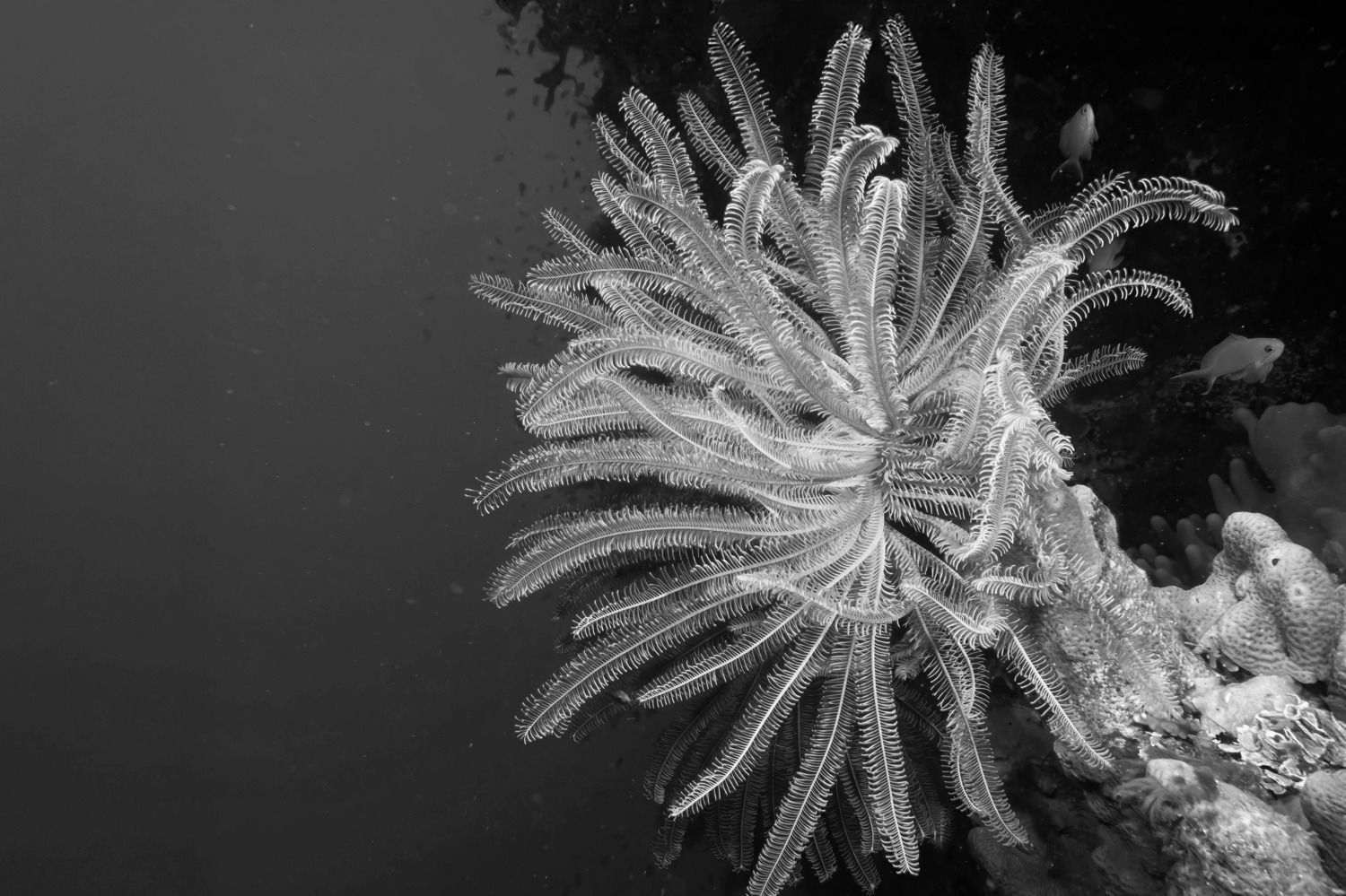
Before the oldest dinosaur, before animals or even plants had expanded onto dry land, ancient relatives of starfish called crinoids, resembling stalked sea flowers, were among the first creatures to flourish in Earth’s earliest coral reefs over 450 million years ago. The study of fossilized crinoids helps scientists understand how these animals evolved and offers rare insight into the origins of complex life. However typical fossilization preserves only the hardest parts of an animal, like shells or skeletal plates, leaving soft tissues and much of their biology a mystery. Now, an extraordinarily rare discovery by University of Oklahoma paleontologists provides a nearly unprecedented look at some of the ocean’s first animals.
“After an animal dies, soft tissues like skin, eyes, or internal organs are the first things to decay,” said Dr. Lena Cole, OU paleontologist and assistant curator of invertebrate paleontology at the Sam Noble Oklahoma Museum of Natural History. “Most fossils are only made up of hard parts like bones, teeth, or shells. Soft tissues are only preserved when the environment acts almost like a natural refrigerator or vacuumsealer—conditions that are incredibly rare.”
The nearly impossible natural conditions required to preserve soft tissue as fossils mean that the preserved tube feet of Dendrocrinus simcoensis, described by Cole and her colleagues in a groundbreaking new study, represent one of only two known examples of fossilized soft tissue in crinoids. It’s also the oldest example discovered to date. “Preservation like this is truly one in a million,” Cole added. “Crinoid fossils number in the millions, and this is only the second time soft tissues have ever been found.”
The Oldest Crinoid Soft Tissue Ever Found “It’s incredible these soft tissues have survived more than 450 million years,” said Dr. David Wright, another OU paleontologist and assistant curator of invertebrate paleontology at the Sam Noble Oklahoma Museum of Natural History, who coauthored the study with Cole. “For reference, these soft tissues are more than 200 million years older than the oldest dinosaur.”
Tube feet are essential for how crinoids feed, interact with currents, and occupy ecological niches. Their size, spacing, and structure vary depending on habitat and feeding strategy— much like how the shape of a mammal’s tooth reflects its diet.
“Since crinoid tube feet are used for feeding, you can think of them in a similar way to how we think about teeth in mammals,” Wright explained.“Differences in their structure tell us about what kinds of environments a species lived in and how it fed.”
“Comparisons with living crinoids show that the anatomy of this ancient species was very different,”Cole added.“This gives us new insight into how crinoids evolved and how their feeding strategies changed over hundreds of millions of years.”
Insights into Ancient Oceans While the discovery is an invaluable contribution to our understanding of ancient crinoids, its true value may be the clues it provides about the ecology of early Paleozoic oceans, when crinoids were among the many early animals to flourish in reef environments.
“Fossilized remains of longextinct species can show features well outside the range of variation we see in living species,” Wright said.
“By comparing ecological ways of life for extinct and modern species, we can understand how patterns of adaptive evolution have changed through time and what factors shaped the modern biosphere.”
Because so few soft tissues are preserved in early echinoderms, each new discovery dramatically expands what scientists can deduce about ancient ecosystems, feeding strategies and evolutionary pathways.
A Discovery Made Possible by Museum Collections Breakthroughs in paleontology are often thought to happen outdoors during field expeditions. While this is sometimes the case, many of the most important discoveries are made among specimens already collected, cataloged and preserved in museum collections.
“New fossil discoveries ultimately come from fieldwork, but museum collections play a significant role in this kind of integrative research,” Wright said. “We don’t always know the full significance of the specimens we collect. New technologies, ideas or expertise often find surprising ways to utilize existing specimens to make new discoveries.”
The fossilized soft tissue of Dendrocrinus simcoensis had been preserved for years at Montréal’s Musée de paléontologie et de l’évolution, a small institution supported entirely by community donations. However, when crinoid specialists Drs. Cole and Wright examined it closely during a research visit, the specimen’s true scientific importance became clear.
“This discovery highlights the importance of museum collections and the community support that keeps them alive,” Cole said. “Without the dedication of many people caring for these collections, this research would never have been possible.”
The invertebrate paleontology collections curated by Drs. Cole and Wright at the Oklahoma Museum of Natural History are home to more than a million specimens, with new fossils added every year. With so much material at hand, it becomes clear why new species and discoveries are still waiting to be found within museums.
“This is why we work to make our collections accessible to researchers around the world,” Wright said. 'There are simply too many fossils to study over one person’s career. There’s more than a lifetime’s worth of discoveries waiting to be found.”