
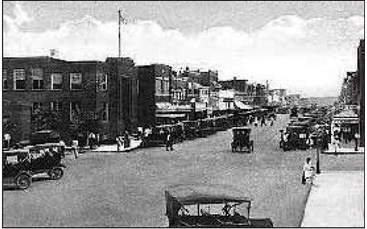
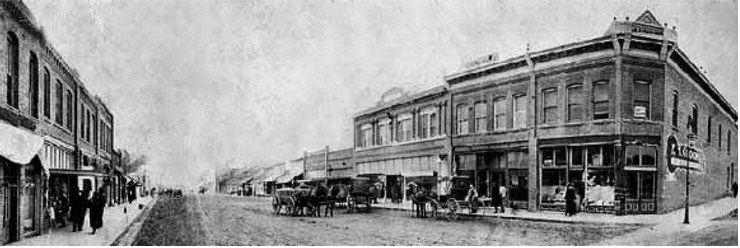
Bristow began in 1898, when the St. Louis– San Francisco Railway ('SL&SF') built a track between Sapulpa and Oklahoma City. The town was named for Joseph L. Bristow, an Assistant U.S. Postmaster General who later served as a U.S. senator from Kansas. A post office was established April 25, 1898. By the 1900 census, the population was 626.
Bristow was designated as the county seat for Creek County at statehood when its population was 1,134. However, the county held a special election on August 20, 1908, to decide whether the seat would remain in Bristow or move to Sapulpa, which claimed to be more centrally located. Bristow had a larger population and claimed to have better railroad connections. Sapulpa won the election, but Bristow claimed voting irregularities. The election was voided and a new vote was held November 20, 1912. Again, Sapulpa won the election and the title of county seat.
The local economy depended heavily on cotton. Bristow had seven cotton gins and two cottonseed oil mills in the early 20th century. Other farms in the surrounding area produced corn, peanuts, potatoes and fruit. Oil and gas were discovered in the area around 1915. The discovery led to the construction of three refineries and four pipeline companies by 1930. The Oklahoma-Southwestern Railway built a short line from a connection with the SL&SF at Bristow through the oilfields to Slick in 1920, but declining oilfield production and other factors lead to abandonment of that trackage in 1930. The peak census population was 6,619 in 1930.
Bristow is located in northern Oklahoma, just south of the geographic center of Creek County. According to the United States Census Bureau, the city has a total area of 3.6 square miles (9.3 km2), of which 3.6 square miles (9.2 km2) is land and 0.08 square miles (0.2 km2), or 1.66%, is water. Bristow is on Interstate 44, Oklahoma State Highway 66 (the old Route 66), Oklahoma State Highway 48, and Oklahoma State Highway 16.
Interstate 44, the Turner Turnpike, passes through the northern part of the city, with access from Exit 196. I-44 leads northeast 20 miles (32 km) to Sapulpa and 33 miles (53 km) to downtown Tulsa, and southwest 76 miles (122 km) to Oklahoma City. Oklahoma State Highway 66, formerly U.S. Route 66, passes through the center of Bristow and generally parallels I-44.
From its inception, Bristow's economy centered on agriculture, and specifically on growing and processing cotton. By the early 1900s, Bristow had seven cotton gins and two cotton-seed oil mills. Additionally, other farmers in the area produced corn, peanuts, Irish potatoes, and fruits.
Oil and natural gas were discovered nearby in 1914 - 1915, producing an economic boom lasting until 1923.The boom also caused a population spike. According to the Encyclopedia of Oklahoma History and Culture, nearly 31,000 people lived within a few miles radius of Bristow in 1920.
Although the boom cooled by 1925, by 1930 the city was the site of three oil refineries, four pipeline facilities and offices for several petroleum- related companies. KFRU, one of Oklahoma's first radio stations, started broadcasting from Bristow in January 1925.
Some manufacturing facilities were added during the 1960s, including Bristow Mattress Factory, the Glassmarc Corporation (manufacturer of fiberglass boats and other items), Artemis Incorporated (manufacturer of women's garments), and the U.S. Carpet Company Jones Memorial Airport (FAA ID: 3F7), about 3 miles to the southwest, contains a 4001’x75’ asphalt runway completed in June 2020. The airport has an annual economic impact of $7.2 million. Commercial flights go in and out of Tulsa International Airport, about 40 minutes away.
Rail freight service is provided by the Stillwater Central Railroad. Passenger trains no longer stop in Bristow, but the Bristow Historical Train Depot & Museum is open for visitation, complete with the original wood floors from 1923.
The Freeland Center for the Performing Arts opened in 2009. The 795-seat theater cost $6.1 million, paid for by a combination of public and private funding. The Center opened with a concert, but is dedicated to diverse experiences which promote a spirit of cultural enjoyment.
Klingensmith Park is a 320-acre facility featuring Lake Massina, as well as the NRHPlisted Klingensmith Park Amphitheater, which was a WPA project from 1936 dedicated by Eleanor Roosevelt in 1937, and still in use.
The Town Square opens onto Historic Route 66/Main Street. It is complete with a small amphitheater and is the site of many community activities.
The Leon Pinson Sports Complex, previously the Bristow Sports Complex, has two softball fields and two baseball fields, as well as the Bristow Rodeo Grounds.
The VFW Post 3656 Wake Island Memorial, complete with a display of artillery and military equipment, commemorates the Battle of Wake Island during World War II.
Bristow Golf & Country Club has a public 9-hole regulation-length course.
Heyburn Lake is about 13 miles to the northeast. RV and tent camping is available, and the lake features picnic areas, a playground, a boat launch, swimming and fishing.