

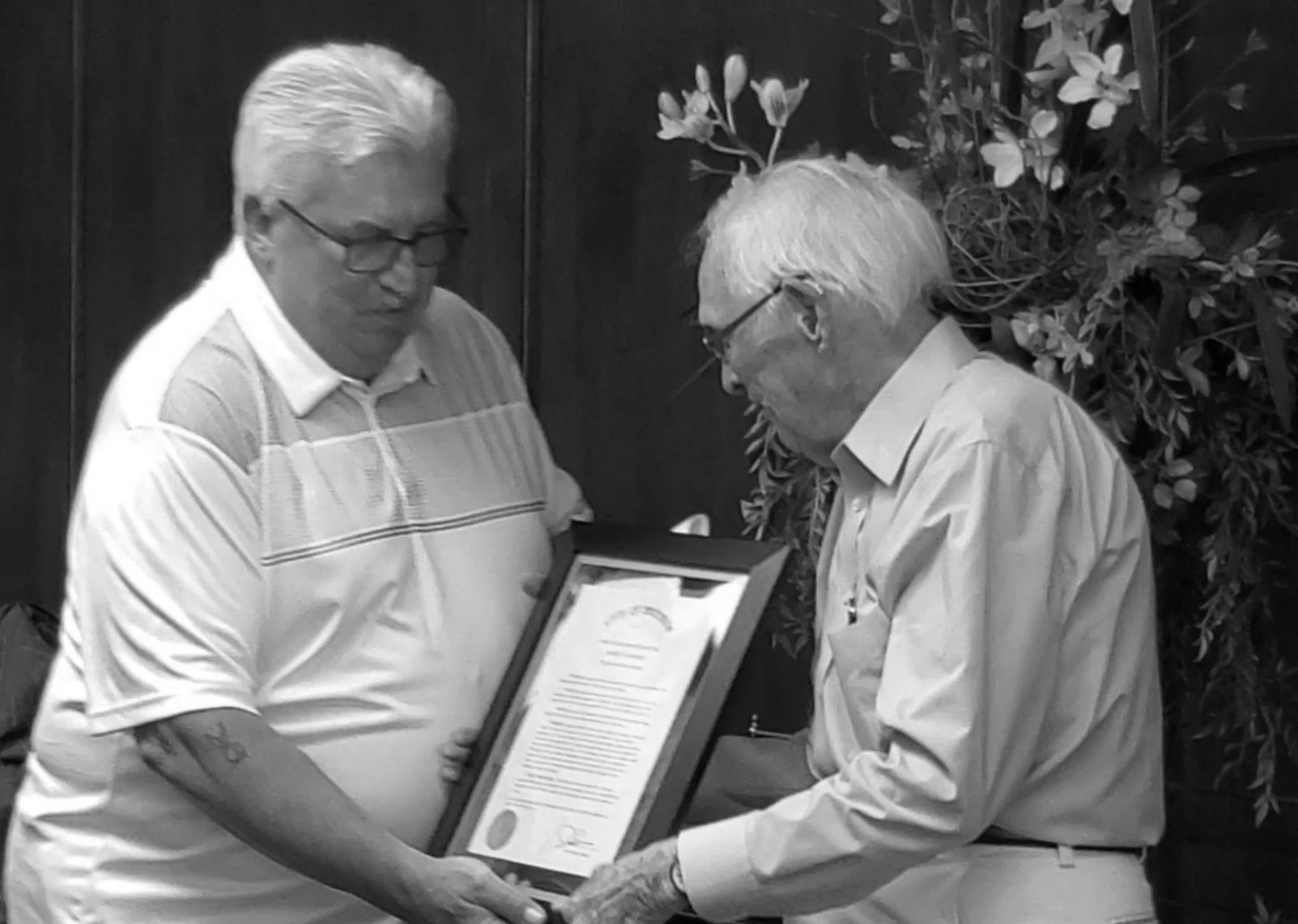
Few people have lived as full and rich a life as George William Krumme. Recognizing his storied life and extensive contributions to Bristow, Mayor Rick Pinson issued a proclamation to Mr. Krumme, proclaiming him Bristow’s “Citizen of the Century” in a ceremony attended by esteemed community leaders and Krumme family members held at Community Bank on the afternoon of May 17th. George graciously shared his story.
Born Dec. 15, 1922, to Roy Archibald and Ruth Bryan Krumme, George was the fourth of five children. He was born on his father’s Tuskegee farm, northeast of Okemah near Pleasant Valley School. Two sisters, Margaret and Rachel, and a brother, Harlan, preceded him in birth to the family. A younger brother, Jeff, followed less than two years later.
George’s parents, each originally from Missouri, moved to the Okemah area of Oklahoma in the early 1900s, where they met. On June 19, 1912, they married and started their family in the years that followed on their farm. Roy farmed his land and worked as a mail carrier at the time. He was hardworking and ambitious, qualities his children learned as well. In 1924, Roy leased the Tuskegee store and cotton gin along with a few thousand acres of land. George would later clerk that store in his teenage years during summers.
The school at Tuskegee was small and only ran through the eighth grade. The Krumme children all attended it, even if only for a short while. In fact, their maternal aunt Nellie Wofford taught the first four years. It is due to his Aunt Nellie that George began and graduated from school earlier than his siblings and other children.
In 1928, Nellie’s son Charles began school at the same age as other children: six years of age. Nellie wanted George to begin school with his cousin, so he started his education at age five. George and his siblings continued their classes at the school until 1930, when the family moved to Bristow.
Being 18 miles from both Okemah and Bristow, the family only lived on the family farm full-time until it became time for the third child, Harlan, to attend junior high school. In 1930, with the majority of the family’s children attending school 18 miles away in Bristow, it made more sense to move. According to George, Bristow proved the most logical choice because, like the family farm, Bristow was a part of Creek County. The roads to Bristow were also easier to pass with significant rainfall. The family returned to Tuskegee during the summers and on Saturdays. On Sundays, the family returned to Bristow for church services at the First Baptist Church.
As a teenager, George clerked the Tuskegee store. When he was 13, his father opened the Krumme Truck and Implement Agency on East 7th Street in Bristow. Later, George briefly worked for his father as a salesman, attempting to sell milk separators to local farmers; however, George chuckled recounting his brief stint as a salesman, saying he never made a single sale. No one was buying milk separators as farming in the area fell out of popularity.
Meanwhile, George and his siblings continued their schooling at Bristow schools. When he was 15 and as his junior year closed, he attended an end-of-year celebration at the skating rink west of Sapulpa. Several of those attending all rode together on the same truck. He was seated and paired with Edwynne “Eddy” Rollestone Freeland. The event served as their first introduction. He began seeing her then and continued with her until they later married. Since he began school early, he graduated early at 16 years of age. Eddy still had a couple more years to complete.
After graduation, he continued to see Eddy and began his college education at Oklahoma A&M in Stillwater. For the first year, he focused his education on becoming a band director. Before his second year, he changed his major to pre-law. He excelled in his studies and was a member of Blue Key, a men’s leadership and service fraternity, but as World War II raged, he suspected the U.S. might soon become involved. Desiring to be married and well-positioned in advance of the draft, he made two decisions. First, in a decision he later regretted, he left Oklahoma A&M to attend Spartan School of Aeronautics, learning meteorology and hoping to be exempted from the draft. Second, George married Eddy in 1941.
While attending Spartan, the U.S. was pulled into the war after the Japanese attacked Pearl Harbor on December 7, 1941. Consequently, the Army Air Corps needed people to train pilots as well as weather instructors. Spartan shut down. Despite being only 19, George became employed as a weather instructor by the Civil Service in Texas.
George went to Perrin Army Air Field in Sherman, Texas as a weather instructor. He soon learned from his father and friends that he was to be drafted. Not wanting to lose him, the head of the air field suggested that George enlist with the Army Air Corps, promising that he could continue teaching as a private. He continued teaching, being promoted to corporal to enhance his authority with students about his same age and rank.
In an effort to become an officer, George moved to Claremont, California at the end of 1942 to enroll in meteorology courses at Pomona College. George said he remained at Pomona until the training program was discontinued due to need of additional forces. At that time, he applied for the Army Specialized Training Program, another decision he regrets. He was sent to the ground forces via the replacement depot in Oregon, assigned to the 274th Infantry Regiment, 70th Infantry Division, Company G and trained as a machine gunner in the weapons platoon. Following training, he shipped out to Europe.
During his time in the war, George received a few awards, including the Purple Heart—an award he says he received “for a scratch.” He was also awarded the Silver Star and a battlefield commission at the Battle of Wingen-sur-Moder, France. For his commission, he was made a second lieutenant. George explained that second lieutenants held extremely dangerous positions and were greatly needed. Although he was promised training before being thrown into the fray, he received little to no training, assuming the position immediately.
As the war came to a close, George was appointed a special services officer. In that position, he arranged activities and trips for servicemen. Additionally, he was later assigned the duty of recording the company’s history for the regiment. After the first lieutenant in charge of the project transferred out, George took the lead. Although he left before the project was completed, he delights that he is credited as an editor for the piece.
In 2001, at the age of 78 and long after the war ended, George authored an account of his time in the war titled “The Big War … and me” for those compiling a historical collection of the experiences of Company G during World War II and also for his grandchildren. Interestingly, the account is not his only written work. George is quite the author, having also penned scientific papers, newspaper articles, and books about his family.
After George and his brother Harlan returned home following the war, his father offered each of them the opportunity to share ownership of Krumme Oil Company, which he founded in the 1940s. Harlan already had his degree in petroleum engineering and had accepted the offer. George also accepted the offer with the caveat that he first be allowed to go back and complete his education, which he subsequently did.
George returned to Pomona College in Claremont to complete his degree. Unfortunately, he did not accumulate enough math courses to receive the degree he desired. He was, however, inducted into Phi Beta Kappa, the nation’s oldest academic honor society. In 1947, after completing one final semester, Pomona awarded him a Bachelor of Arts degree with a concentration in math. George returned to Bristow and became a partner in Krumme Oil Company with his father and older brother. With time, he and Harlan accrued increasing ownership shares of the company, eventually buying out their father many years later as he retired.
While at Krumme, George filled many roles, including becoming a father. In 1948, George and Eddy welcomed their first of two sons, David. Their second son, Robert, entered their lives two short years later, in 1950. For those first years of the boys’ lives, George continued to work at Krumme, and Eddy reared the boys until Robert began school around age 6. At that time, she opted to enroll and commute to the University of Tulsa (TU). In 1960, the family moved to Tulsa to aid her pursuit of higher education. She studied at TU many years, ultimately earning her master’s and doctoral degrees in French. She later went on to teach at Memorial High School and TU in Tulsa.
During the 60s, George also decided to return to school, taking night classes at TU while putting his years of experience at Krumme Oil to work. In 1966, he earned his Master of Science in petroleum engineering. He later went on to earn his Doctor of Philosophy in geosciences in 1975 from TU as well.
It was also during the 60s when Eddy and George became very active in politics. Being active Democrats, they sponsored Washington Week in Review on television, introducing Krumme Oil to OETA sponsorships in subsequent years as well. During the 1968 presidential election, George managed the Tulsa presidential campaign for Eugene McCarthy and also attended the Democratic National Convention in Chicago. In subsequent years, George acted as a delegate and secured his position as the Oklahoma Democratic National Committeeman from the 70s through the 90s, an uncommon feat at the time.
Prior to his passing in 1975, George’s father had been a board member of Community Bank. After his death, Harlan and George alternated serving on the board until the Fosters decided to sell the bank. At that time, George and Harlan along with David Loeffler, Roger Collins, and Tom McAdams put together a proposal to buy the bank, and they did.
In the early 2000s, both George and Eddy were in their 80s, and Eddy’s health began to decline. During Eddy’s illness, George helped care for her. He also remained active in his Bristow business ventures and even wrote articles for the paper. As Eddy’s health steadily declined, George continued caring for her, his lifelong partner. She suffered illness and dementia, peacefully passing on May 10, 2011. Their son David joined her February 15, 2013, after falling ill and suffering a heart attack.
Then, on July 6, 2013, George married Grace Aldean (Thompson) Newcomb, also originally of Bristow. Though they had not known each other well growing up, their homes were separated by a single house between them in Bristow. George had known her older brother, Warren, and been involved in activities with him.
While George attended night classes at TU in the 60s, he had a classmate, a geologist named Joe Newcomb—Aldean’s then husband. With George’s background and ownership in Krumme and Joe’s occupation as a geologist, they ran in some of the same circles, casually bumping into one another throughout the years at events and picnics. In this way, George and Aldean remained acquainted with one another. Although Joseph Newcomb died in 2003, Aldean and George occasionally and briefly visited at common fundraising or church events.
Following the loss of their spouses, the two rekindled their friendship, growing closer and ultimately deciding to marry. George and Aldean live together in Tulsa today. Like Eddy, Aldean’s health is in decline. George continues to support her. He reads to her and cares for her. While she rests, George works on new and ongoing projects. He is currently finalizing his latest manuscript, “Tales of Our Town: Early Bristow, OK”.
In wrapping up, George had a few parting thoughts and wise insights he shared when asked how he felt after being proclaimed Bristow’s “Citizen of the Year.” He answered:
“Pleased. Surprised. Astounded. I had no idea. I just couldn’t believe it. You don’t even know what century: the last 100 years, the twentieth century, or the twenty-first? I am unique in the sense that I’ve lived a long time and lived a pretty interesting life, for me at least. A varied life. And I’ve been lucky. I’ve had a good family, a competent family. My mother was never past the 8th grade, but she was a smart woman. My father was a very capable person. They all have failings. I have failings. We all do. I’m not unique that way, but it really was awfully nice of them. I’m proud of it. It was nice of them. It is a recognition that people respect you. Thank you.”