
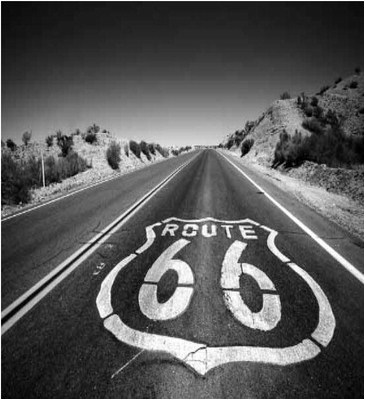
U.S. Route 66 (US 66 or Route 66), also known as the Will Rogers Highway, the Main Street of America or the Mother Road, was one of the original highways in the U.S. Highway System. US 66 was established on November 11, 1926, with road signs erected in 1927. The highway, which became one of the most famous roads in the United States, originally ran from Chicago, Illinois, through Missouri, Kansas, Oklahoma, Texas, New Mexico, and Arizona before ending in Santa Monica , California, covering a total of 2,448 miles. US 66 served as a primary route for those who migrated west, especially during the Dust Bowl of the 1930s.
Parts of the original Route 66 from 1913, prior to its official naming and commissioning, can still be seen north of the Cajon Pass. The paved road becomes a dirt road, south of Cajon, which was also the original Route 66.
Much of the early highway, like all the other early highways, was gravel or graded dirt. Due to the efforts of the U.S. Highway 66 Association, US 66 became the first highway to be completely paved in 1938. Several places were dangerous: more than one part of the highway was nicknamed 'Bloody 66' and gradually work was done to realign these segments to remove dangerous curves. However, one section through the Black Mountains outside Oatman, Arizona, was fraught with hairpin turns and was the steepest along the entire route, so much so that some early travelers, too frightened at the prospect of driving such a potentially dangerous road, hired locals to navigate the winding grade. The section remained as US 66 until 1953 and is still open to traffic today as the Oatman Highway. Despite such hazards in some areas, US 66 continued to be a popular route In the 1950s, US 66 became the main highway for vacationers heading to Los Angeles. The road passed through the Painted Desert and near the Grand Canyon. Meteor Crater in Arizona was another popular stop. Notable and nostalgic buildings grace the the sides of Route 66 with many of them listed on the National Registry of Historical places. This includes several buildings located in Bristow. The buildings in Bristow to make the National Registery of Historic places are Bristow Tire, Bristow Motor Company, the Texaco Gas Station, and recently the Masonic Lodge. All of these building grace the sides of the Route 66 Highway.
Route 66 is one of the most toured highways in Oklahoma which runs right through the center of Bristow, which is known as Main Street.