
NO, IT’S NOT FOUND in those bigger burgs where you might expect to find the tallest freestanding neon sign on Historic Route 66. But nestled deep in the rolling hills of the Green Country region of eastcentral Oklahoma, the city of Bristow is home to a cherished local monument to motoring history that lays claim to that prestigious title.
Bristow, with a population of about 4,200, has long been a staunch Route 66 town. It’s about 35 miles southwest of Tulsa and 75 miles northeast of Oklahoma City on State Highway 66 (Historic Route 66), which also serves as its Main Street through the heart of the business district. The Turner Turnpike (Interstate 44) hums nearby in the busy corridor between the state’s two largest cities.
Attracting Attention Just off Bristow’s Main Street (Route 66), Beard Motor Company opened an automobile dealership in 1947 for the Chrysler and Plymouth brands and GMC trucks. Located at 210 East Ninth Street, it was about the distance of two standard city blocks off the main drag. Beard Motor Company was a sought-after destination for truck and auto repair. It offered 24hour service, complete with customer amenities for people who were anxious to get back on the road quickly.
Given its intention to generate business from traffic along U. S. Highway 66 and lacking a direct storefront on that artery, owner Hubert “Red” Beard realized the need for a prominent sign to attract attention. So approximately two years after its debut, Beard Motor Company completed the erection of what was billed in a news report as the “tallest in-dependently suspended sign in the southwest” at that time.
The Chrysler-Plymouth sign became an instant landmark.
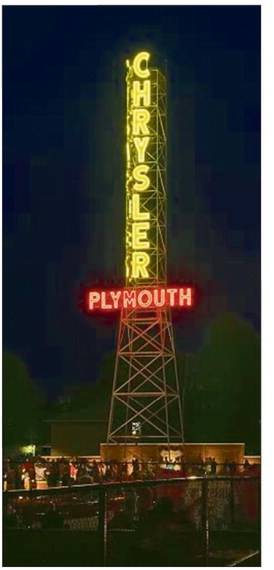
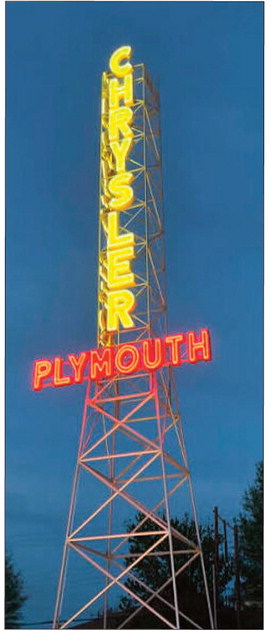
Weighing in at a whopping 20 tons, the steel tower closely resembled an oil derrick, a fa iliar sight around the petrole-um-rich state. The upper section of the tower spelled out CHRYSLER vertically in letters six feet tall. A smaller-scaled PLYMOUTH was positioned below it, extending out horizontally from where the upper and lower sections of the tower meet. The automobile brand names were painted yellow and red, respectively. Exposed neon illuminated CHRYSLER in radiant light that dominated the scene for miles around. And at its 10-story apex, the tower also featured a 25-foot flagpole on its southwest corner.
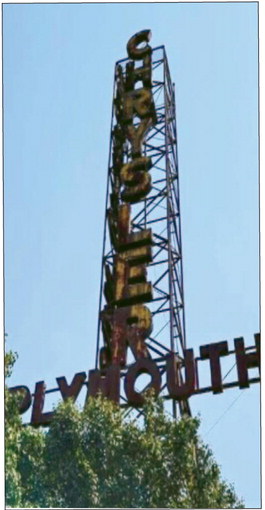
Sadly, less than a decade later, this shining beacon of light seen from miles away went dark after the owner’s death and the closure of the dealership.
For nearly the next 70 years, it remained dark and neglected, its future uncertain.
The National Park Service even designated it as one of the top three “most endangered neon signs” in 2023.
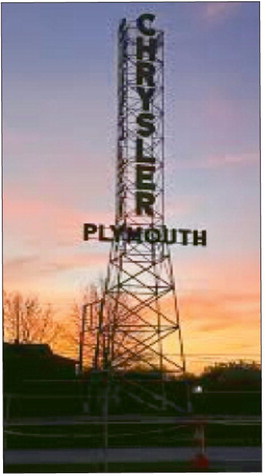
Revitalization During the past six years, the Bristow Historical Society, led by program director Joe Trigalet, worked diligently to secure funds for the restoration of the cherished local icon.The initial efforts via memorial brick sales, other local fundraising activities, and donations from local contributors ultimately led to the approval of a Route 66 Revitalization Grant in 2025 from the Oklahoma Route 66 Commission of the Oklahoma Department of Commerce. This transformative award funded about 75 percent of the approximately $1.1 million project cost to restore the tower and its signage and to relocate it to a new parklike plaza adjacent to Route 66.
A vacant lot on the northeast corner of East Ninth Avenue and North Main Street provided an ideal spot to reposition the Chrysler-Plymouth sign and its supporting tower. The site was formally designated the Chrysler Tower Plaza. A courtyard with ample benches was added, including a rear wall to display donor bricks, with storyboards to share the history of Beard Motor Company, its signature tower, and the restoration.
Empowered with the necessary funding and with an eye on the road’s centennial year, the eight-month development time line culminated with a grand celebration and relighting ceremony for the Chrysler Tower on April 11, 2026.
When the opportunity arose in late June 2026 to visit the Chrysler Tower, the sheer impact of its presence, by day and by night, exceeded my preconceived expectations. And its two-block shift to the edge of Main Street of Bristow, part of the Main Street of America, seems like an ideal setting for a sign now next to the road that gave it its birth.
Taking my leave and heading back east on Route 66, the golden CHRYSLERglow reflected in my rear-view mirror for the first few miles. But the impression it made will remain with me long after its luminous light fades and the miles tick away.
Until we meet again, “Along the Neon Road.” Note: Robert Gehl is team adviser of the Neon Heritage Preservation Committee of the Route 66 Association of Missouri. “Along the Neon Road” will appear in subsequent issues of Route 66 Sentinel.